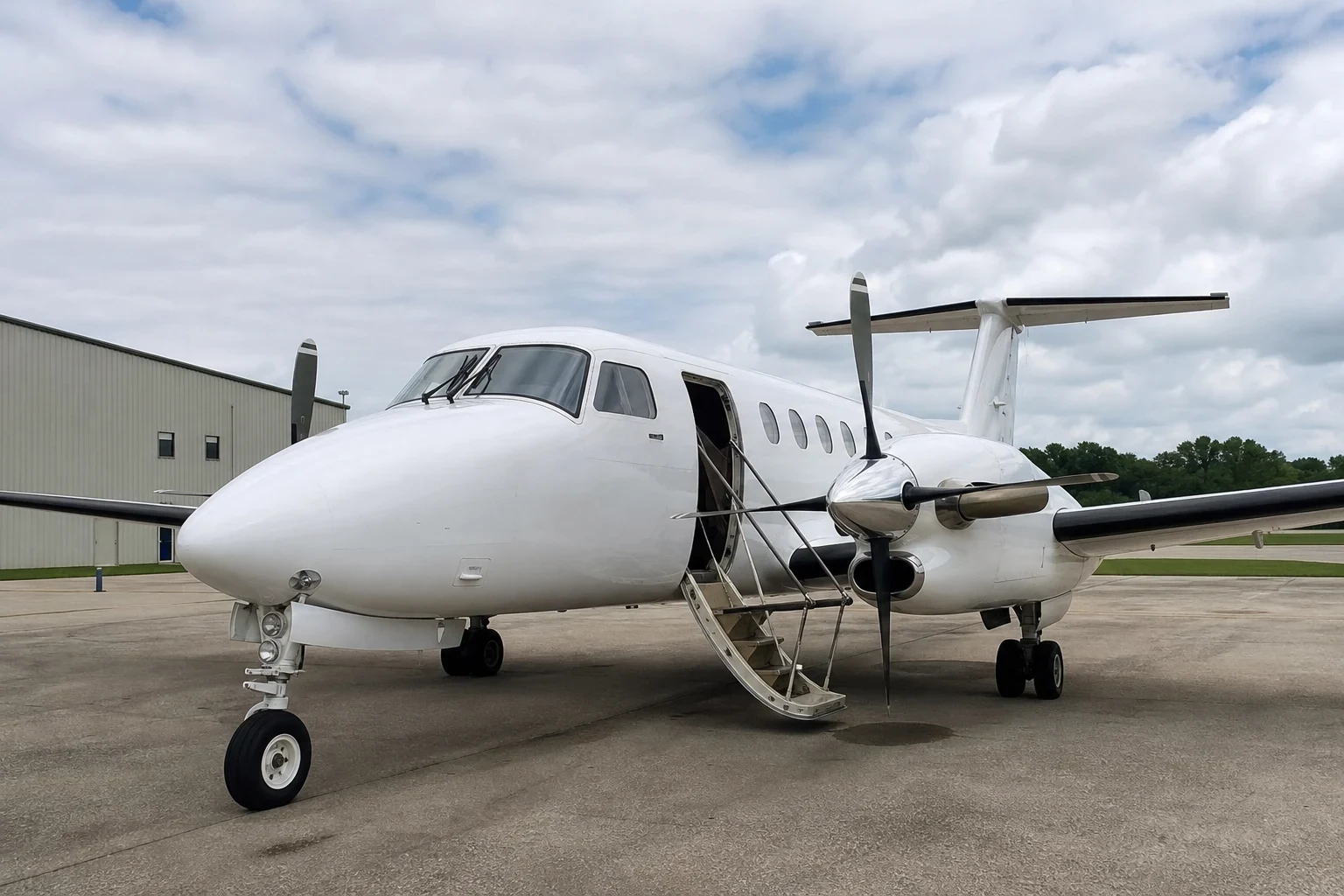
ServicesTurboprop Charter
Turboprop Charter in Pendleton
For a regional trip of a few hundred miles, a turboprop is often the most sensible aircraft to fly. We fit the cabin to your passengers and bags, check the destination runway and the operating rules, then read you a single all-inclusive price over the phone.
Where a turboprop earns its place
Inside a turboprop, a turbine engine drives a propeller rather than pushing exhaust straight out the back. That design burns less fuel per hour than a jet and stays efficient at lower altitudes, so it suits legs of roughly 150 to 600 miles. The models we see most often on charter are the Pilatus PC-12 and the Beechcraft King Air 200 and 350, seating about six to eight passengers.
The other advantage is runway performance. Many turboprops can take off and land on strips under 4,000 feet, so you can fly into a small field near your meeting, a lake town or a farm-country plant instead of a busy hub an hour's drive away.
If your trip is longer, or you want to fly above more of the weather at higher speed, a light jet or midsize jet may be the better tool. We will tell you plainly when that is the case.
Covered on every turboprop trip
- An aircraft picked for your trip
- Your route, headcount and luggage settle which aircraft we offer. A PC-12 has a wide rear cargo door that swallows golf bags and sample cases easily, and a King Air 350 adds a second engine and more seats.
- Each leg priced on its own
- A one-way flight is billed as one way. You never cover round trip pricing so the aircraft can get back to its base.
- A price with everything in it
- Fuel, crew, taxes, and landing and FBO fees are already part of our number, so nothing hidden appears on a bill after you arrive.
- Runway and operator checked
- Before we confirm, we hold the destination runway's length, surface and approach up against the aircraft's published performance. We also check that the operator is authorized for the type of flying your route needs.
- Room for your dog, WiFi for your work
- Dogs ride in the cabin with you. If you plan to answer messages or join a video call in the air, mention it on the call and we will limit the search to aircraft with onboard WiFi.
Signs a turboprop fits your trip
Your destination has a short runway
Small municipal fields often have runways that jets cannot use with a full load. A turboprop lands you closer to where you are actually going.
The trip is regional
For a flight of an hour or two, a turboprop's cruise speed of roughly 280 to 310 knots costs you only minutes against a jet, and the hourly rate is usually lower.
You are moving a small team and gear
Four to six passengers with equipment, tools or luggage fit well in a turboprop's flat-floor cabin and rear baggage area.
You need to go on short notice
We answer the phone around the clock, and turboprops are widely based across the region. That improves the odds of finding an aircraft for an on demand departure.
You want no long term commitments
There are no programs to join and no prepaid hours. You book one trip at a time.
Where your turboprop quote comes from
Flight time sets most of a turboprop charter's cost. Positioning, crew time on the ground and airport fees adjust it from there. You get one all-inclusive number, and knowing its parts makes it easier to compare options.
Flight hours
Time from engine start to shutdown is the largest part of the cost. Headwinds and routing around weather can add minutes on a given day.
Where the aircraft is based
If the nearest available aircraft has to reposition to pick you up, that positioning time is part of the trip. Point to point pricing keeps you from paying for an empty return when you fly one way.
Overnights and waiting time
A same-crew return a day or two later can mean crew lodging and per-diem costs. A quick turnaround on the same day usually costs less than several nights away.
Fees and taxes
Landing fees, FBO handling, de-icing in winter and federal excise taxes vary by airport and season. They are included in the number we give you.
Single or twin engine
A twin-engine King Air generally costs more per hour than a single-engine PC-12. The right choice depends on your route, weather and preference.
How a turboprop charter comes together
- 1
Share your trip with us
Phone us with dates, where you leave from and where you are headed, how many are flying, bags and any pets. Whether you start in Pendleton, Anderson, Fishers or Greenfield, we find the closest practical field to depart from.
- 2
Rules and runway reviewed
In the US, paid passenger charters fly under the FAA's Part 135 rules, covering pilot duty and rest limits, maintenance intervals and weather minimums. A single-engine turboprop needs specific FAA authorization to carry charter passengers in instrument weather, so we verify it before pricing a PC-12 for a trip in cloudy season.
- 3
A single quote
Over the phone we walk through your all-inclusive quote: the aircraft type, the flight time and everything it covers. Nothing gets booked until you agree.
- 4
The day you fly
Get to the FBO about 15 to 20 minutes ahead, bypass the terminal lines and board with your crew. If weather or a mechanical problem changes things, we phone you ourselves with your options.

Turboprop charter questions
Is a single-engine turboprop safe for charter flights?
Single-engine aircraft like the PC-12 use the Pratt and Whitney PT6 turbine, an engine with a long service record. Carrying charter passengers in instrument weather takes a specific FAA authorization and added equipment, and we check the operator has it before booking. If you would rather have two engines, we can quote a King Air.
How far can a turboprop go without stopping?
With a normal load, many turboprops fly 800 to 1,200 miles nonstop, and farther with fewer passengers. More weight means less range, so we calculate it from your actual passenger and bag count. For longer trips we compare a fuel stop with a light jet.
How much luggage can we bring?
It depends on the model and overall weight, since fuel, passengers and bags all count against the same limit. The PC-12's cargo door makes loading golf bags and larger cases simple. Give us the number of pieces and their approximate size when you call so weight and balance work out.
Is the ride bumpier than a jet?
A turboprop cruises lower than a jet, usually in the low to mid 20,000-foot range, so summer afternoon heat can mean more convective bumps. The cabin stays pressurized. On a long day or in heavy weather, we may suggest a morning departure or a jet instead.
Can I fly one way only?
Yes. We price point to point, so a one-way trip gets a one-way quote, never round trip pricing.
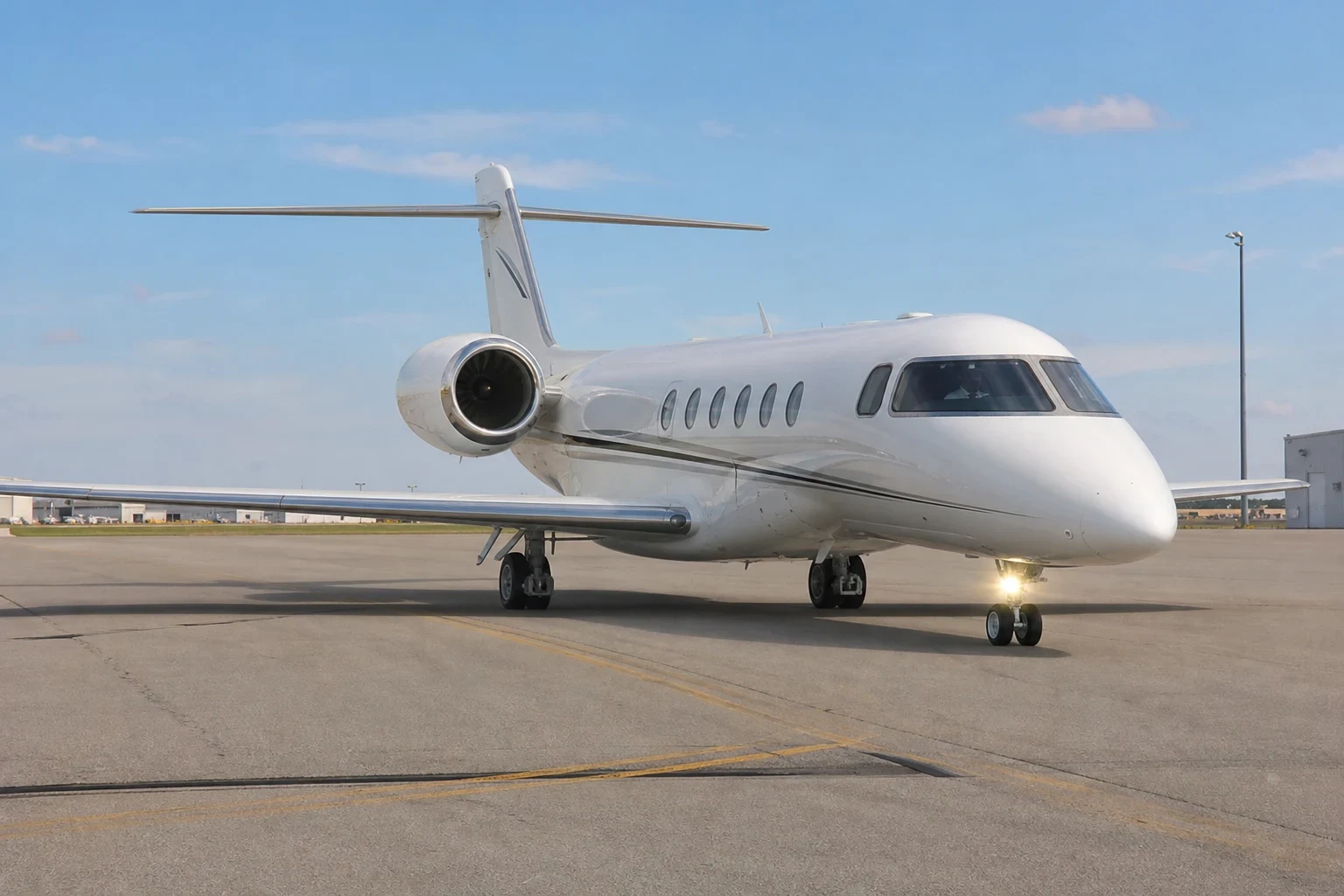
Plan your next regional flight
Share your destination, dates and passenger list. We will pair the trip with a turboprop that suits the runway and the route, then walk you through an all-inclusive quote.